
Dear Geographers,
We are delighted to welcome you to the 63rd German Geography Congress, which will take place in Bonn in 2027 under the theme “Critical Zones”.
Critical zones are spaces where complex processes, conflicts and contradictions converge. They are where crucial decisions about the future are made. The theme therefore provides a strong framework for the central congress of the German-speaking geographical community, bringing together the diverse perspectives of our interdisciplinary field.
We look forward to inspiring presentations, stimulating discussions and many opportunities to meet and exchange ideas. See you in Bonn in September 2027!
The German Geographical Society (DGfG) and the Bonn Local Organising Committee
Leading up to the dkg‘27
15 September – 1 November 2026
Submission of proposals for sessions
By 23 December 2026
Review of proposals by the Local Organising Committee
15 January – 28 February 2027
Submission of presentation and poster proposals
By 21 March 2027
Review by the chair
13. – 17.09.2027
German Geography Congress
Der Ortsausschuss ist bestrebt, allen dkg´27-Besucher*innen eine diskriminierungsfreie, respekt- und vertrauensvolle Kongressteilnahme ermöglichen. Das Awarenessverständnis beachtet die Prävention durch die Sensibilisierung der Teilnehmenden und Verantwortlichen, Verhaltenskodizes und Schulungen ebenso wie strukturelle Maßnahmen Rückzugsorte und Awareness-Points.
The Bonn Opera House, with its terrace overlooking the Rhine, provides a festive setting for the opening ceremony. Please note that seating capacity for the opening ceremony is limited. A separate ticket must therefore be booked as part of your dkg`27 registration.
The dkg´27 starts on Monday 13 September with Young Geography Day and ends with the field trips on Friday 17 September.
The main congress days (Tuesday to Thursday) follow a consistent schedule: two sessions in the morning, followed by two keynote or lunch lectures. A further two to three sessions take place in the afternoon, with special events scheduled for the evening.
The sessions of the dkg´27 are developed through a two-stage process based on proposals from the geographical community. In the first stage, proposals for sessions can be submitted. Each session is chaired by two people who should ideally be affiliated with two different institutions. They serve as session chairs.
Sessions are 75 minutes long and may take a variety of formats. The standard format is a presentation session featuring four presentations. Other formats are also possible, including lightning sessions with more than four presenters, panel discussions, and other formats.
In the second stage, presentation proposals can be submitted for presentation sessions and lightning sessions. A distinction is made between presenters and authors. A maximum of two presenters may be designated for each presentation; their names will be included in the congress programme.
The session chairs then review the submitted proposals. Sessions with three or more accepted presentation proposals will be included in the congress programme. Once the maximum number of presentations for a session has been reached, further proposals may be assigned to other suitable sessions. If a particularly large number of presentation proposals is submitted for an individual session, an additional time slot may be allocated in consultation with the Local Organising Committee. The aim is to give as many congress participants as possible the opportunity to present their work.
From 15 September to 1 November 2026, proposals for sessions at dkg’27 can be submitted. Sessions are 75 minutes long and may take the form of presentation sessions, lightning sessions, panel discussions, or other suitable formats. Lectures (45 minutes) are also submitted through the session submission process.
Sessions are generally chaired by two people. Once a session has been accepted, the session chairs are responsible for quality assurance, the review and selection of submitted contributions, and communication with the presenters.
Detailed information on formats, roles, procedures, and responsibilities can be found in the Guidelines for Session Chairs, which will also be available from 15 September 2026.
From 15 January to 28 February 2027, presentation proposals can be submitted for presentation sessions and lightning sessions. A distinction is made between presenters and authors. A maximum of two people may be designated as presenters for each presentation and will be named in the congress programme. Additional contributors who have made a substantial contribution may be listed as authors in the abstract.
Presenters are expected to attend the congress in person. The participation of all other listed authors is also strongly encouraged, as dkg´27 is intended to foster professional exchange within the geographical community.
Posters will be presented on site as part of a traditional poster session. Congress participants will have the opportunity to view the posters and engage directly with the authors. During designated time slots, authors will have the opportunity to give a brief presentation of their posters and will then be available at their posters for questions and discussion.
Excursions can be offered in a variety of formats. Short excursions of one to three hours will take place alongside the congress programme, while half-day and full-day excursions will be offered on Friday.
To enable as many people as possible to participate actively, the number of roles each person may take on at dkg‘27 is limited. Each person may serve as a session chair no more than once and as a presenter no more than once. The poster exhibition is organised independently of the sessions.
Lorem ipsum …
Lorem ipsum …
Lorem ipsum …
Arbeitskreise haben über ihre Mitgliederversammlungen hinaus die Gelegenheit, eigene Sessions anzubieten. Die Veranstaltungen der Arbeitskreis sind im Rahmen des normalen Einreichungsverfahrens anzumelden.
Der Schwerpunkt der Tages- und Halbtagsexkursionen liegt am Freitag, den 17. September. Während der gesamten Kongresswoche werden zudem kürzere Stadtspaziergänge, Besichtigungen und Führungen zu den unterschiedlichsten Themen in Bonn und vorzugsweise im Umfeld des Campus Poppelsdorf angeboten. Grundsätzlich ist eine vorherige Buchung des gewählten Angebotes notwendig.
The official opening ceremony will take place at the Bonn Opera House; separate tickets are required and can be purchased when registering for the DKG. The event will feature musical accompaniment by the University of Bonn Jazz Choir. A standing reception with refreshments is planned afterwards in the foyer of the Opera House.
Am Mittwochabend wird gefeiert! Auf der DKG-Party im Brückenforum auf der rechten Rheinseite an der Kennedybrücke kann darf das Wissenschaftliche in den Hintergrund treten. Es die Musik darf laut sein, es darf getanzt, aber kann natürlich auch genetzwerkt werden. Für die Party ist ein gesondertes Eintrittsticket notwendig.
Die Veranstaltung ist eine schöne Gelegenheit, unser Fach in den Mittelpunkt zu stellen und im Kreise der geographischen Verbände und Gesellschaften zu feiern. Gemeinsam möchten wir herausragende Beiträge der Geographie würdigen, aktuelle Entwicklungen beleuchten und neue Impulse diskutieren
„Energizer-Pausen“ werden vom „hochschulsport bonn“ angeboten. Ein Klassiker, um die Geister zu erfrischen und die Konzentration zurückzuholen.
Lorem ipsum …
„60 Minuten Campus Poppelsdorf“ bietet die Gelegenheit zu kurzen „Geh-Sprächen“ im direkten Umfeld der Tagungsstätte. Kurze Führungen bieten Hintergründe zu den Botanischen Gärten, den Nutzpflanzengärten der Universität, der CampusAckerdemie der Biologiedidaktik, dem Poppelsdorfer Schloss und der Alten Chemie, dem einst größten Institutsgebäude der Welt. Kostenlose Tickets (kontingentiert) können am Infopoint im Hörsaalzentrum erfragt werden.
„Museumsbesuche“ sind mit einem kostenlosen DKG-Museumsticket möglich. Diese sind während der gesamten Kongresswoche und dem anschließenden Wochenende gültig und können am Infopoint im Hörsaalzentrum erfragt werden. Folgende Museen können Sie mit dem DKG-Museumsticket besuchen:
XXX
The JKG 2027 is hosted by GeoDACH e.V. and organised jointly with the student council of the Department of Geography at the University of Bonn. The JKG begins on 11 September and requires separate registration. The dkg´27 will kick off on Monday 13 September with the Young Geography Day. Both JKG and dkg´27registrations are valid for this themed day.
The 2027 Annual Conference of the German Society for Geomorphology (Deutsche Gesellschaft für Geomorphologie e.V.) will take place as part of dkg´27 .One focus is on the special theme day on Wednesday, 15 September.
The Applied Geography Day will take place on Thursday, 15 September. On this day, the German Association for Applied Geography (DVAG) will focus on professional practice in geography, with dedicated sessions and additional activities.
The school geography programme on this day is aimed particularly at teachers and students training to become teachers.
Critical Zones – that is the theme chosen by the local committee for the dkg‘27 in Bonn. It embodies the multi-perspective nature of geography and focuses on both the physical environment and social phenomena.
In critical zones , complex processes, conflicts, and contradictions converge. They are places where crucial decisions about the future are made. Since antiquity, the concept of the “zone” has been used to delineate and describe geographical spaces. Today, the “Critical Zone” refers to the thin layer at the Earth’s surface in which numerous processes essential to life take place. It has therefore become a key concept in Earth system science. The dramatic consequences of human-induced environmental degradation are particularly evident here. Social tensions and conflicts can also be made tangible as critical zones in their spatial context. At the same time, critical zones are not only sites of crisis. They can also become spaces of transformation, where power relations are challenged and alternative forms of society can emerge. kritische Zonen in ihrer Räumlichkeit greifbar gemacht werden. Zugleich sind kritische Zonen aber nicht nur Orte der Krise. Sie können auch Räume der Transformation werden, in denen Machtverhältnisse herausgefordert und andere Gesellschaftsformen möglich werden.
With its theme the dkg’27 invites participants to engage with critical zones in research, education, and professional practice.
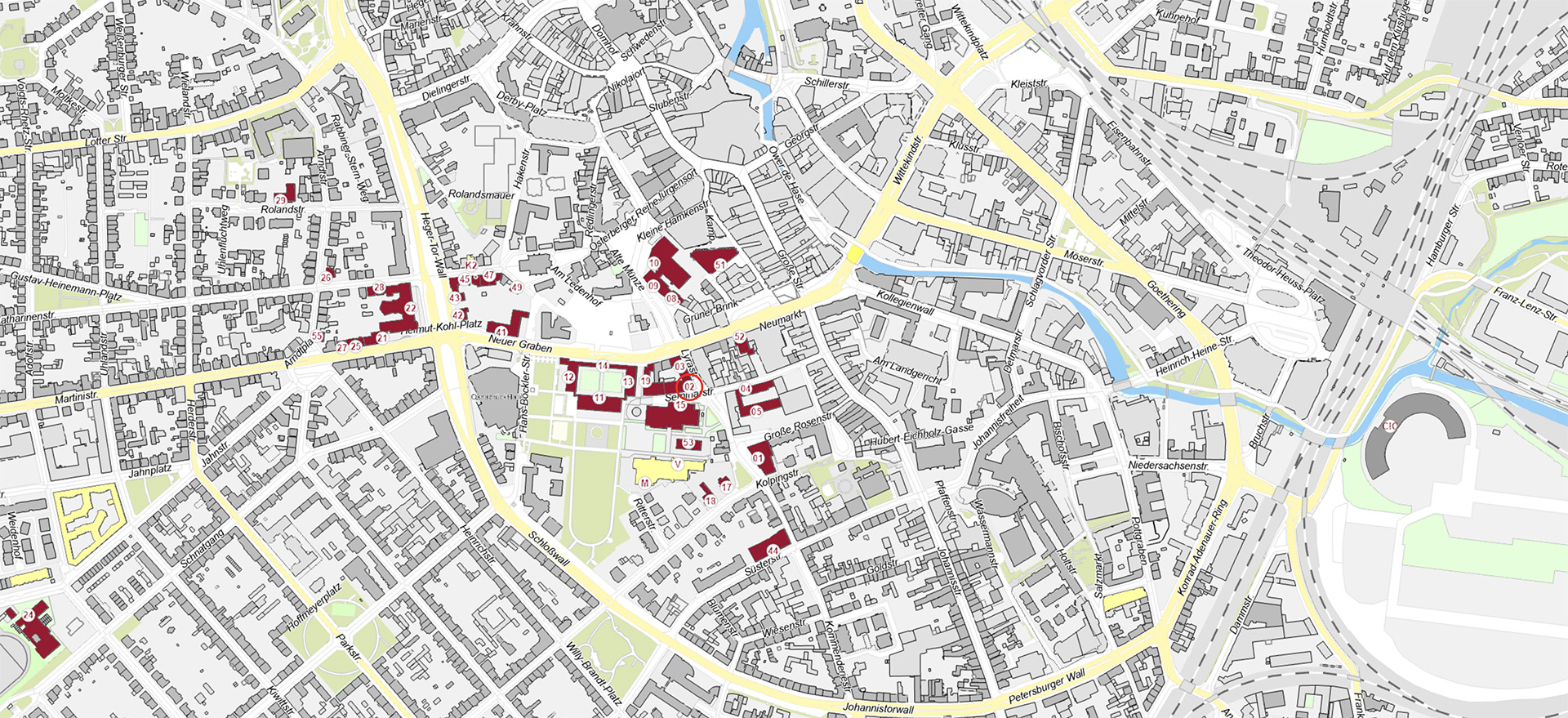
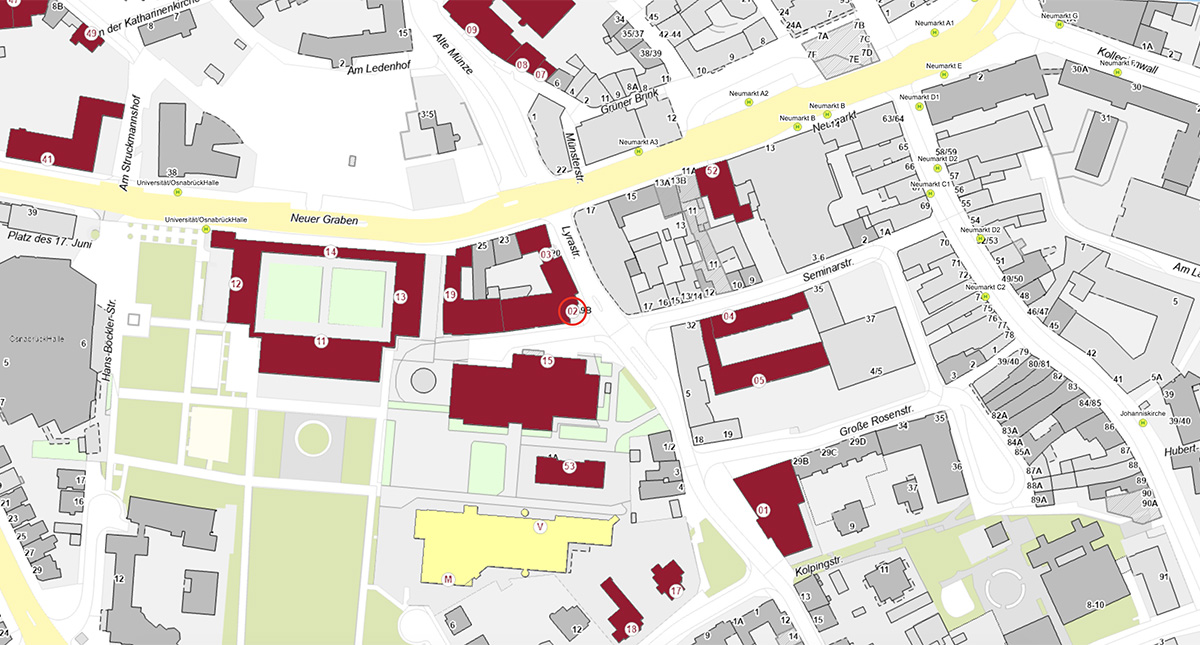
The University of Osnabrück's city centre campus can be reached on foot in approx. 15 minutes (1.2 km) or by bus lines M2, 14, 15, 16 and 17 (to the Neumarkt stop).
General Admission: Regular: 289 EUR Early Bird: 239 EUR
Member Pass (VGDH, DVAG, HGD, VDSG, GeoDACH): Regular: 239 EUR Early Bird: 189 EUR
Student General Admission: Regular: 179 EUR Early Bird: 149 EUR
Student Member Pass (VGDH, DVAG, HGD, VDSG, GeoDACH): Regular: 119 EUR Early Bird: 99 EUR
General Admission:
Early Bird: 239 EUR (Regular: 289 EUR)
Member Pass (VGDH, DVAG, HGD, VDSG, GeoDACH):
Early Bird: 189 EUR (Regular: 239 EUR)
Student General Admission:
Early Bird: 149 EUR (Regular: 179 EUR)
Student Member Pass (VGDH, DVAG, HGD, VDSG, GeoDACH):
Early Bird: 99 EUR (Regular: 119 EUR)
All information on registration and participation fees will be published well in advance of the start of registration.
Registration will be open from February 2027.
Registration is possible via the following button:
Members of geographical associations receive attractive discounts.
Next to the information desk, you will find coat racks, lockers (large enough for a daypack and jacket), and designated luggage storage areas. The area will be supervised but not guarded. Items are left at your own risk.

Der Campus ist mit den mehreren Buslinien angebunden (siehe Anreise).
Der Campus ist mit den mehreren Buslinien angebunden (siehe Anreise).
Der Campus ist mit den mehreren Buslinien angebunden (siehe Anreise).
Registration will be open from February 2027. The dkg´27 will take place on the Poppelsdorf Campus, which is also home to the University of Bonn’s Department of Geography. From Bonn Central Station, the campus can be reached on foot in approximately 16 minutes via Meckenheimer Allee or Endenicher Allee. Several bus routes also serve the campus (see “Getting There”). The address of the main lecture hall centre is: Friedrich-Hirzebruch-Allee 5, 53115 Bonn.
The University of Osnabrück's city centre campus can be reached on foot in approx. 15 minutes (1.2 km) or by bus lines M2, 14, 15, 16 and 17 (to the Neumarkt stop).
During the congress, the information desk and congress office will be located in the main lecture hall centre on the Poppelsdorf Campus. Registration will also take place there. The address is: Friedrich-Hirzebruch-Allee 5, 53115 Bonn (not a postal address!). For enquiries prior to the congress, please contact: dkg@geographie.de Friedrich-Hirzebruch-Allee 5, 53115 Bonn (keine Postanschrift!). Kontaktinformationen bis zum Kongress: dkg@geographie.de
Accommodation must be booked individually. When searching, please check for sustainability certifications for the accommodation and support the DKG27’s commitment to sustainability. In addition to the In addition to the usual booking portals, specialist sites such as the Bio Hotels Portal, Good Travel and FairWeg help you to filter your search specifically by environmental standards.
The Geography Students’ Association helps students find affordable accommodation, offers advice on couchsurfing and helps them find flatmates.
The University of Bonn sees itself as a sustainable institution. As a public body, it has a particular social responsibility to lead by example. The local committee of the dkg´27 in Bonn, the overarching mission statement ‘WE for Sustainability – Mission Statement of the University of Bonn’ serves as a framework for conference planning, and the university maintains close contact with the Vice-Rectorate for Sustainability. Organising a sustainable large-scale event is a challenging goal, but the university is committed to contributing to sustainable transformation processes.
Alongside a climate-neutral energy supply during the conference, raising participants’ awareness of environmentally friendly travel options, the selection of certified accommodation, a waste management plan, the targeted involvement of regional businesses and products, and so on, aspects of social sustainability are given high priority. The promotion of equal opportunities and the recognition of diversity are fundamental principles, as is ensuring that participation in the conference is socially accessible. A framework is being established specifically to ease the financial burden on students and to enable those with greater financial means to sponsor other participants’ fees.
A sustainability scorecard will subsequently provide the local committee and the public with information on the extent to which the organisation’s self-image has been realised and how wide the gap is between its aspirations and the empirical reality.


The local committee is overseeing the preparations for the dkg´27 based in Bonn. He contributes local specialist expertise, supports organisational coordination with the university and helps to organise the conference.
Prof. Dr. Britta Klagge ist seit 2012 Professorin für Geographie mit Schwerpunkt Wirtschaftsgeographie am Geographischen Institut in Bonn. Ihre Forschungsschwerpunkte sind die geographische Energie- und Infrastrukturforschung, Finanzgeographie und Globaler Wandel in wirtschaftsgeographischer Perspektive. Frau Klagge ist seit 2026 Sprecherin (2022 – 2025 Co-Sprecherin) des Sonderforschungsbereichs TRR228 Future Rural Africa.
Sie ist die Vorsitzende des Ortsausschusses für den DKG 2027 und Mitglied des Kernteams für die Gesamtorganisation des Kongresses.
Prof. Dr. Nadine Marquardt ist seit 2016 Professorin für Sozialgeographie am Geographischen Institut in Bonn. Sie beschäftigt sich hauptsächlich mit Fragen rund um das Wohnen und das Zuhause. Ihre Arbeit baut auf Theorien und Methoden aus den Bereichen Governance, Wissenschafts- und Technikforschung, der feministischen und der kritischen Theorie auf. In ihrem aktuellen und von der DFG geförderten Forschungsprojekt beschäftigt sie sich mit Smart Homes für ältere Menschen.
Frau Marquardt vertritt als Mitglied des Ortsauschusses DKG 2027 insbesondere die Perspektive der Humangeographie.
Prof. Dr. Eva Nöthen ist seit 2023 Professorin für die Didaktik der Geographie am Geographischen Institut der Universität Bonn. Zuvor war sie wissenschaftliche Mitarbeiterin an der Goethe Universität Frankfurt. Ihre Arbeitsschwerpunkte sind Visuelle Geographien, Künstlerische Forschung, Transformative Geographische Bildung, Klimawandelbildung.
Frau Nöthen vertritt als Mitglied des Ortsausschusses DKG 2027 insbesondere die Perspektive der Geographiedidaktik und der Geographie in der Schule.
Prof. Dr. Julian Klaus ist seit 2021 am Geographischen Institut der Universität Bonn als Professor für Physische Geographie mit dem Schwerpunkt Hydrologie tätig. Zuvor war er am Luxemburg Institute of Science and Technology beschäftigt. Seine Forschungsschwerpunkte sind die Kritische Zone der Erde, Einzugsgebiets- und Prozesshydrologie, numerische Modellierung und Ökohydrologie. Er leitet mehrere Drittmittelprojekte finanziert von der Deutschen Forschungsgemeinschaft und von der Volkswagen Stiftung. Außerdem ist er in zahlreichen Organisationen der wissenschaftlichen Community tätig.
Julian Klaus vertritt als Mitglied des Ortsausschusses DKG 2027 insbesondere die Perspektive der Physischen Geographie.
Apl. Prof. Dr. Manfred Nutz war nach Professurvertretungen in Bremen, Bonn und Dortmund von 2007 bis 2024 Kustos am Geographischen Institut in Bonn. Er wurde 2004 an der Universität zu Köln zum außerplanmäßigen Professor ernannt. In Forschung und Lehre hat er sich mit stadt-, regional- und bevölkerungsgeographischen Fragestellungen in Deutschland beschäftigt. Nach seinem Ausscheiden aus dem aktiven Dienst hat er u.a. organisatorischen Aufgaben unter dem Aspekt einer nachhaltigen Veranstaltungsplanung für den DKG 2027 übernommen.
Er ist Mitglied des Ortsausschusses und gehört zum Kernteam für die Gesamtorganisation des Kongresses.
Patrick Hainbuch hat das Studium Bachelor of Science Geographie am GIUB 2025 abgeschlossen und ist nun Masterstudent im Studiengang „Geography of Environmental Risks and Human Security“ an der United Nations University, Institute for Environment and Human Securtity (UNI-EHS). Er engagiert sich als Studierendenvertreter u.a. in der Fachschaft Geographie des GIUB. Seine fachlichen Interessen liegen in der Physischen Geographie.
Patrick Hainbusch vertritt als Mitglied des Ortsausschusses die studentischen Interessen und ist Ansprechpartner für den JKG (Junger Kongress Geographie) in der DKG-Planung für 2027.
Members of a geographical professional association receive reduced ticket prices. Membership therefore offers additional benefits.







08:00
09:00
09:30
10:00
10:30
11:00
11:30
12:00
Excursions & Walking Talks
12:30
Registration
13:00
Welcome
13:30
14:00
14:30
Keynote
15:00
B R E A K
15:30
16:00
16:30
Workshops
17:00
B R E A K
17:30
18:00
18:30
Pitch & Connect
19:00
19:30
From 8:00 PM
Pub Night
08:00
09:00
09:30
10:00
Sessions
10:30
B R E A K
Workshops
12:30
13:00
B R E A K
13:30
14:00
14:30
Excursions & Walking Talks
15:00
B R E A K
15:30
16:00
16:30
17:00
B R E A K
17:30
18:00
18:30
19:00
19:30
From 8:00 PM
Party
08:00
09:00
09:30
10:00
Panel-Discussion
10:30
B R E A K
B R E A K
14:30
15:00
15:30
16:00
Excursions & Walking Talks